What Makes Leather So Important?
Leather is a core crafting material required for a wide range of recipes. In the early game, you need it for Pelt Armor, basic bags, and the first set of saddles for your starting Pals. As you progress, leather shows up in mid-grade armor sets, upgraded Pal Gear, and the equipment that unlocks Partner Skills for your utility Pals. The demand ramps up sharply around level 20 to 40, when you are equipping a full team and exploring harsher biomes.
Because leather is used in moderate to high quantities throughout the entire game, you cannot rely on a single farm method. Active hunting will carry you through the first few hours, but passive production becomes essential once you start building a dedicated base. Understanding the full toolkit of leather acquisition methods will keep your crafting queue flowing without interruption.

Active Leather Farming, Best Pals and the Bridge of the Twin Knights Route
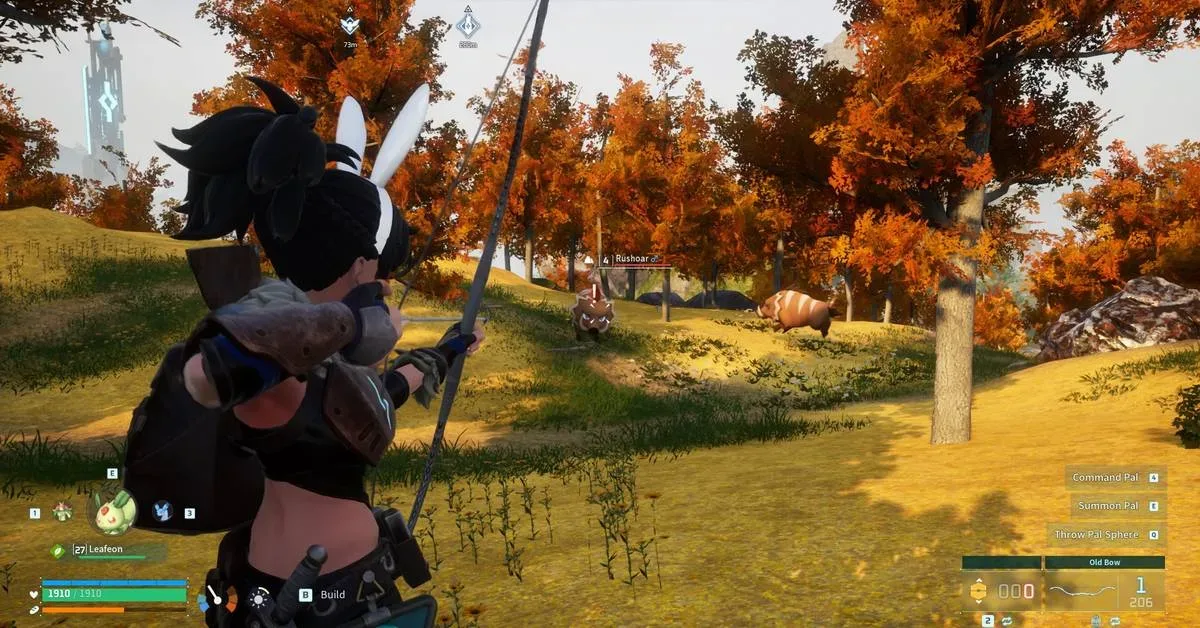
The most straightforward way to get leather is to catch or kill Pals that drop it. While many Pals in Palworld yield leather, two stand out as the best early-game targets: Rushoar and Eikthyrdeer. Both spawn in the starting grassy areas, are easy to defeat, and drop leather reliably. For the most efficient active farming route, focus on the area around the Bridge of the Twin Knights, located in the grassy plains north of the Plateau of Beginnings where the path crosses a wide stone bridge. This location is frequently cited by the community as having the highest density of leather-dropping Pals in the early and mid game.
To farm effectively, simply run a loop across the bridge, catching or killing every Rushoar and Eikthyrdeer you see. Catching provides experience and resources, while killing yields loot directly. A good rhythm is to capture a few Pals, then butcher them later (more on that in a moment). The loop takes under a minute and can produce 10-15 leather per circuit depending on spawn luck.
Why not other Pals? Direhowl, Melpaca, and even some larger creatures also drop leather, but their spawn rates are lower or they appear in less convenient locations. The Bridge of the Twin Knights route remains optimal well into the mid game, and advanced players often return here when they need a quick burst of leather for a specific project.
Passive Leather Farming, The Surfent Ranch Method
If you want leather without lifting a finger, the answer is Surfent. Surfent is the only Pal in Palworld that produces leather when assigned to a Ranch. Once you place a Ranch at your base, capture a Surfent (found near water bodies in mid-game areas like the eastern coast or around the central lake), and assign it to the Ranch, it will begin generating leather automatically over time.
Community testing indicates a rate of roughly one leather per minute per Surfent (estimates vary based on Pal work speed and base conditions). While not explosive, this passive production adds up quickly if you scale up. A dedicated ranch with three or four Surfents can supply all your leather needs for mid-to-late-game crafting, leaving you free to focus on other activities.
To maximize efficiency, pair your Surfent ranch with a dedicated hauling Pal like Faleris, which will automatically collect the dropped leather and deposit it into your storage. Alternatively, check the ranch periodically and grab the leather manually. The key is to set up this farm as early as possible, even if you have to hunt a bit to capture your first Surfent. By the time you reach level 30, passive production will have already saved you hours of active grinding.

Alternative Methods, Merchants and the Meat Cleaver Butcher Trick
Beyond hunting and ranching, there are two more tricks worth knowing. First, leather can be purchased from certain NPC merchants in Palworld. The most reliable source is the Wandering Merchant near the Small Settlement fast travel point, who typically sells leather for 50, 80 gold coins each. Merchant inventories rotate, so you may need to revisit multiple times. Leather costs a few gold coins, making this a good option when you are flush with cash but short on time. Always glance at a merchant’s stock when passing through a settlement.
Second, the Meat Cleaver butcher trick is a game-changer for active hunters. When you capture a Pal using a Pal Sphere (rather than killing it in the wild), you can later use a Meat Cleaver on that captured Pal at your base to harvest extra leather. This effectively doubles the leather yield from each caught Pal, because you get the initial drop when you catch them, and then additional leather from the butchering process. To obtain a Meat Cleaver, craft it at a Primitive Workbench after unlocking the technology at Level 8 (requires 10 Wood and 5 Stone).
To execute this: Capture a Rushoar or Eikthyrdeer, return to your base, open the Pal box, select the Pal, and choose the “Butcher” option with a Meat Cleaver in your inventory. Note that this consumes the Pal permanently, so only use it on common Pals you don’t plan to keep or breed. For maximum efficiency, combine this method with your active hunting route: catch a full inventory of Rushoar, then head back to base and butcher them all at once.
Efficient Farming Strategies, Combining Methods
The most efficient approach changes as you progress through the game. Here is a stage-by-stage breakdown of how to blend these methods.
Early game (levels 1, 20): Focus on active hunting at the Bridge of the Twin Knights. Catch as many Rushoar and Eikthyrdeer as you can, then butcher them with the Meat Cleaver. As soon as you can safely capture a Surfent, build a Ranch and start passive production. Even one Surfent will help during downtime.
Mid game (levels 20, 40): Expand your Surfent ranch to three or more Pals. Continue active hunting when you need a quick leather injection, but rely on the ranch for bulk production. Check merchants in settlements when you pass through; sometimes you can buy 20 or 30 leather for a modest sum. Use the Meat Cleaver on any extra captured Pals, especially if you are hunting for XP or other resources.
Late game (levels 40+): Your Surfent ranch should cover nearly all your leather needs. Active hunting becomes optional, reserved for large crafting sessions or when you need a sudden batch for a new gear tier. Consider breeding Surfent to produce more ranch specialists rather than hunting wild ones. The passive farm will keep you stocked indefinitely.
One important reminder: leather drop rates and merchant inventories are community-validated, not officially documented by Pocket Pair. Palworld is still in early access, and mechanics may shift with future updates. Always keep an eye on patch notes and adjust your strategies accordingly.
The Leather Supply Chain That Works
Leather farming does not have to be a grind if you set up the right systems from the start. Prioritize capturing a Surfent early to kick off passive production. Combine that with targeted active hunting along the Bridge of the Twin Knights route, and always use the Meat Cleaver on captured Pals to squeeze out every last piece of leather. Merchants provide a convenient backup when you are passing through settlements. Set up your Surfent ranch by Level 15 and you’ll never spend more than five minutes hunting leather again.






Comments
Join the Conversation
Share your thoughts, ask questions, and connect with other community members.
No comments yet
Be the first to share your thoughts!